The Last Harvest
The legacy of local winemaker on Taylor’s Island, Pat Neild
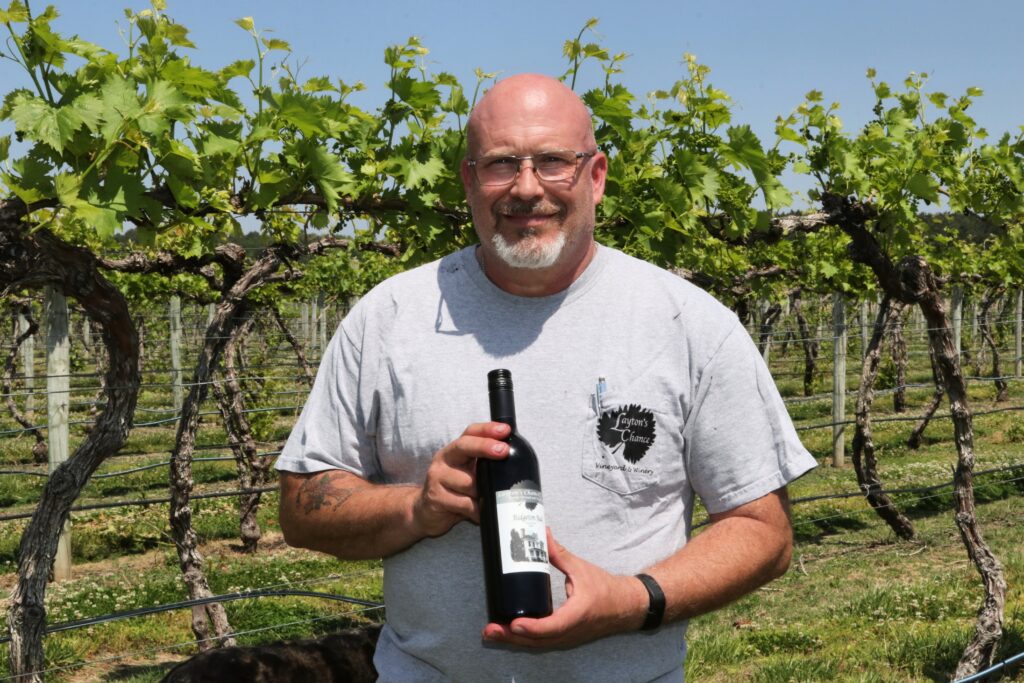
William Layton at Layton’s Chance Winery holding a bottle of Ridgeton
Red, 2025. Layton made this special issue wine as a tribute to Pat Neild, from the grapes Pat Neild grew on his vineyard on Taylor’s Island.
There are several notable wineries on the Eastern Shore today, but they are a recent development. There were no vineyards of commercial wine grapes on the Eastern Shore of Maryland until John “Pat” Neild, planted the first vines in 1973 on Taylor’s Island, near Cambridge, Maryland.
Neild’s legacy lives in the flourishing Eastern Shore wineries we enjoy today, and in a very special vintage of wine made in his honor, Ridgeton Red, which was just bottled by William Layton, of Layton’s Chance Winery near Vienna, Maryland.
“Mr. Pat” as locals referred to him respectfully as a pillar of the community, was born on Taylor’s island in 1930. His family has deep roots there, dating back to 1669. The main house on Ridgeton Vineyards was built in 1860, and it is listed on the National Register of Historical Places.
No Buyers
Bundled up against the cold, Pat could be seen out in the vineyards throughout the winter with gloved hands carefully pruning the bare vines. Through the hot, humid Eastern Shore summers Pat, still vigorous at 95 years of age, was in the vineyards together with his son, Tom and family, nourishing the next crop and fighting off marauding deer, birds, insects, and fungal disease.
Picking and crushing the grapes was a family affair and a celebration that punctuated the end of another perpetual cycle of Nature. But last year, after all the hard labor and expense of growing the grapes, there were no buyers. The wine market has plummeted nationwide.
“Through the years I’d buy his extra grapes when I could,” says William Layton, local winemaker and owner of Layton’s Chance Winery near Vienna, Maryland. “I wanted to support him, especially in the early years when I didn’t have enough grapes.”
But with wine sales down and a surplus of inventory, built up after the high demand during COVID ended, Layton had a glut of wine and more grapes than he could use. In fact, he was selling some of his own grapes. “As much as I like to support him, I had to tell him no. I just don’t need the grapes.”
Pat was out in the fields working through June and July, but as harvest time approached, he suddenly came down with what he thought was a pesky respiratory infection.
“The family told me that he had gone into hospice a week or so before he passed,” Layton recalls.
Upon hearing the sad news, Layton told the family that he would take the entire harvest and make a special wine in honor of Pat. Half of the wine he would give to the family, and the other half he would make available for sale. That special vintage, 2025 Ridgeton Red, was just bottled.
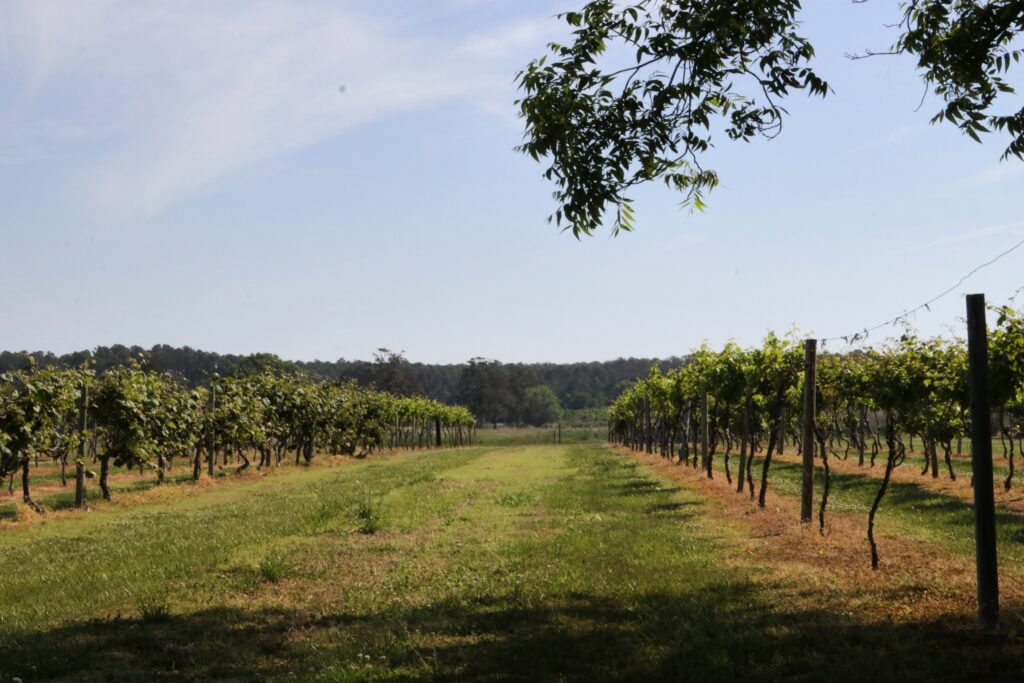
The Ridgeton Vineyard field on Taylor’s Island.
Pat’s Influence on Eastern Shore Winemaking
William Layton credits Pat with his success in taking the risky leap from traditional farm crops to starting a winery in 2005. “I didn’t think corn, soybeans, and wheat were going to support our family for the next generation. To grow your business with corn and soybeans you need to continually acquire land to get bigger.”
He needed something that would bring in more income with smaller acreage. “We looked at a lot of things. We looked at organics, chickens, watermelon, crazy things like alpacas, and ATV trails, but grapes and wine gave us the flexibility to make it as a small farmer.” With no background in wine making or grape growing, Layton decided to visit Pat at his vineyard on Taylor’s Island.
Pat welcomed him into his small wine making room partitioned off inside his large red barn. The sharp scent of balsamic vinegar, red wine, and oak barrels permeated the air, and splotches of puce purple stained the concrete floor. While sampling different vintages from dusty wine bottles, some stored there for years, Pat eagerly shared his knowledge and experience. Pat was a meticulous note taker. He recorded every detail of tending the vines and making the wines over decades.
Leafing through these notebooks now fading and dogeared from age, Pat relived highlights of past vintages, pointing out, as his finger traced over the pages, intricate details of grape growing and wine making. All the dates and results of soil analysis, what sprays were applied to the vines and when were listed. The different recipes of wines made over decades, their chemical analysis, and tasting notes were all recorded.
“I remember it distinctly,” Layton says. Pat told him, “Here on the island once or twice a year the whole vineyard floods with seawater.”
“I said to myself, ‘If he can grow grapes here, I know I can grow grapes in my location.’ I grow very much the same things that Pat grew— Norton, Chambourcin, and Vidal Blanc.”
Ridgeton Red
Ridgeton Red was made once before. “The first Ridgeton Red that I made was in 2019. Pat had a ton of Chambourcin, a ton of Norton, and a half a ton of Vidal Blanc.” Layton crushed it and put it all in the tank together. “It just turned out fabulous–really amazing,” he says. “It was nice to have a wine that was just the taste of Taylor’s Island and Pat Neild’s vineyard.”
Ridgeton Red won Gold Medal in 2022 in the Maryland Governor’s Cup wine competition.
“I did kind of the same thing [this time],” Layton says. “I am really happy with it. It doesn’t taste exactly like the last one. Every year is different, but it’s a nice wine.” The unique conditions on Taylor’s Island and the combination of varieties Pat grew create an outstanding wine like no other. “The Norton is a very dark grape. It adds deep red color and an earthy heaviness. The Chambourcin gives it a little berry fruitiness, the raspberry, blackberry, cherry, flavors, and the Vidal lightens it up a bit and makes it a nice easy drinking wine.
Layton’s wife, Jennifer, handles marketing and she decides when to release each vintage.
She says she plans to release it on June 20, 2026. “I have such a limited quantity, it will probably sell out quickly, because there are a lot of people who are interested in that last vintage,” her winemaker husband adds.
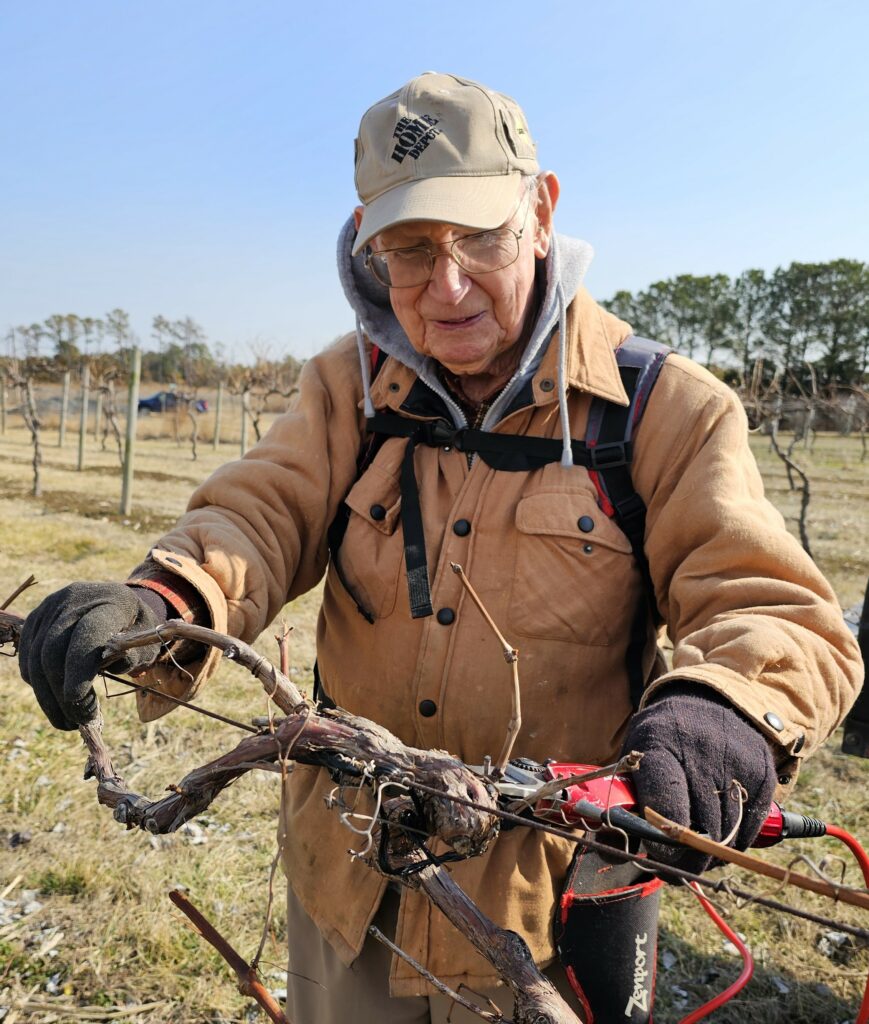
“Mr. Pat” still pruning grapes at age 95.
Local Wine Builds Community
Layton says he was surprised by how much support his winery has received from the local community. He expected people would enjoy his wines on the porch at his scenic winery, but he didn’t expect much sales in stores. “We sell a ton in stores, and our biggest areas are Cambridge and Salisbury.”
Like the fusion of local grape varietals that make this region’s unique wine, a fusion of local farmers, winemakers, and merchants creates a close-knit community here on the Eastern Shore. “Right now, we are capping 80 flats of strawberries from Emily’s Produce to make our strawberry wine. All the watermelons for our watermelon wine come from the Harding family right outside Vienna.”
In a poignant scene in the 2004 movie Sideways, Virginia Madsen portraying the character Maya, delivers a beautifully poetic passage about wine, written by Alexander Payne and Jim Taylor. It captures perfectly Pat’s last harvest and Layton’s devotion in crafting the 2025 Ridgeton Red in Pat’s honor:
“I like to think about the life of wine… that it’s a living thing; that it connects you more to life. I like to think about what was going on the year the grapes were growing.
I like to think about how the sun was shining that summer and what the weather was like. I think about all those people who tended and picked the grapes. And if it’s an old wine, how many of them must be dead by now. I love how wine continues to evolve, how every time I open a bottle the wine will taste different than if I had uncorked it on any other day, or at any other moment. A bottle of wine is like life itself — it grows up, evolves and gains complexity. Then it peaks and begins its steady, inexorable decline.”
Postscript: Unique Character of Eastern Shore Wines
People have been making wine around the world for hundreds or thousands of years, and over that expanse of time vintners have found the specific varieties of grapes that are best suited to their local soil, weather, and geographic conditions. For example, different varieties of grapes are grown on opposite banks of the Gironde estuary in Bordeaux France. Cabernet Sauvignon flourishes on the gravelly shores of the Left Bank, but on the opposite bank Merlot thrives in the clay and limestone soil. Grapes from both banks make world-class fine wines, but figuring out what to plant where took generations of trial-and-error.
Even though the earliest settlement in the state of Maryland was on Kent Island, in 1631, commercial vineyards on the Eastern Shore are only about twenty years old. (This is apart from Pat Neild’s pioneering 50 year-old vineyard on Taylor’s Island, but even that is a comparatively short period of time.) With an estimated 5,000 to 10,000 named grape varieties in the world, which ones would be best to plant on the Eastern Shore was a quandary faced by growers starting their vineyards here.
“I started with the same things that Pat started with,” says William Layton of Layton’s Chance Winery near Vienna, Maryland.
“I can’t grow a lot of the traditional grapes that people expect,” he says. “I don’t make the big Cabernet Sauvignons that have been in the bottle for 18 months, partly because I can’t grow those grapes, but I think the grapes we grow make really good wines.”
“I stuck with very much the same things that Pat grew—Norton, Chambourcin, Vidal Blanc, and I added a couple of new varieties, Cab Franc and Traminette.”
Although Napa and Cambridge, Maryland are situated on almost the exact same latitude, the environments are very different. “This area is about as nontraditional of a vineyard as you can get,” Layton says. “We are not on elevation, only eight feet above sea level. We are not on gravelly soil. We have really nutrient rich soil, and grape vines are supposed to be stressed. We are right next to woodlands, so you can have a lot of disease and insects. I stuck with the ones Pat said would grow well in this location.”
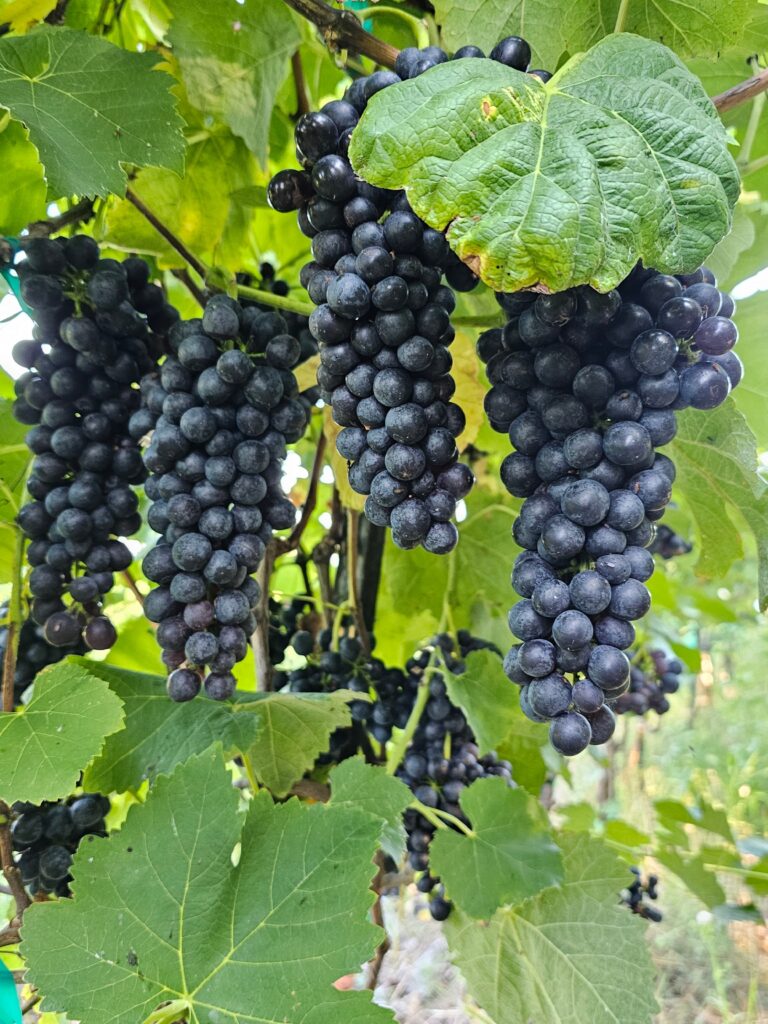
Layton says that Norton and Chambourcin work well together because Norton is a heavier earthier grape whereas Chambourcin is much lighter, both in color and flavor. “I compare Chambourcin in that respect to something like a Pino Noir, so together they make a really nice, well balanced red. Norton gives it a little spiciness. Chambourcin gives it a little berry fruitiness, the raspberry, blackberry, cherry flavors, and a fruity aroma. The Vidal lightens it up a bit and makes it a nice easy drinking wine. Norton earthiness is almost like a wet dirt earthy aroma, and it mixes well with the others. It lends hints of leather and wood.”
People differ at least as much as grapes do in different locations, so that is also a defining factor in wines grown on The Shore.
In contrast to France and Germany, there is not a long tradition of fine wine drinking on the Eastern Shore. Layton tailors his wine for local tastes, noting that people generally begin their experience with wine by drinking sweeter wines. He was not a wine drinker before starting his winery.
“I started at the beginning, like most people do, with sweet wines. Then moved on to rosés, to dry whites, and finally to dry reds. I went through that whole progression,” he says. “So, we make wines for a lot of different tastes.”
The unique character of a fine wine that derives from its local soil and weather is called “terroir,” a French word referring to “land.” The wine world has not caught on to the wonderful Eastern Shore terroir originating from Taylor’s Island. They likely never will, because the small family-run wineries make something special, just for locals.
First published in the Cambridge Spy
All photos by R. Douglas Fields