The Morbid Curiosity of Watching a Daredevil Risk His Life
Why people are drawn to watching free soloist Alex Honnold risk his life
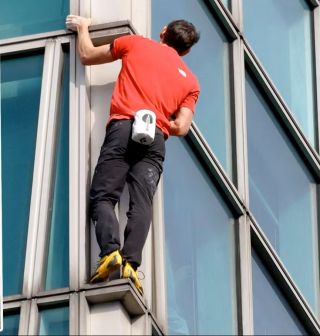
The psychopathological reasons for daredevils, like free soloist Alex Honnold, risking their life for spectacle and thrill are well known. But that psychological aberration pertains to only a few. The more pertinent question is: Why are normal people irresistibly drawn to watching the horror of someone potentially losing their life?
Whenever there is a wreck on the freeway, traffic is backed up in the opposite direction for miles, not because the lanes are obstructed, but because people rubberneck to take in as much of the gore as possible. Some 84 percent of the adult U.S. population consumes true crime stories in books, TV, and podcasts, making real-life horror and gore a major form of entertainment. Morbid curiosity as entertainment is surging, with 15 of the top 20 documentaries on Netflix in 2024 being true crime sagas, compared with only six titles in 2020.
This attraction to life-threatening horrors is an ingrained aspect of the human psyche, not a new phenomenon. The long, dark history of public hangings, and the numerous amphitheaters in ancient Rome, once filled with stadium crowds to watch criminals and Christians eaten alive by wild animals, shows how people are attracted to deadly events like moths drawn to a lightbulb. Why are people compelled to watch someone risk death or being killed?
The psychology of morbid curiosity
There are several reasons that people are drawn to grisly events. Some authorities propose that by observing a life-or-death event in safety, we can learn how to avoid or overcome the danger. That is reasonable, perhaps, for rubbernecking on the highway and ambulance chasing, but was the massive audience drawn to the live stream of Honnold risking his life to climb a skyscraper, glued to the tube to learn how to avoid falling off the side of a building? Clearly, that explanation falls short. (Pun intended.)
The popularity of horror movies and murder mysteries provides more compelling insight into the psychology of morbid curiosity. People don’t devour James Bond movies because they aspire to be secret agents. As any writer knows, plot is driven by the stakes a character faces, and the stakes could not be higher than a person facing impending death.
Arousal and novelty are strong pulls on attention, but that fact only begs the question; it does not explain why we are so drawn to deadly drama.
Other authorities explain morbid curiosity by noting that novel or arousing things have importance in the evolutionary sense. In the evolutionary sense, humans survived by foraging and hunting, and spotting a plant or potential prey item sparks arousal. However, that plant could be edible or poisonous, just as an animal in the bush could be prey or predator. The need to make an instantaneous decision about a novel encounter, whether it is beneficial or dangerous, links novelty with arousal.
Threat detection is critical for survival, which is why expansive neural circuitry is devoted to threat detection. That neural circuitry spans the entire brain to engage all the senses, powerful emotional responses, and high-level decision-making, to instantly dictate our behavior to approach or avoid the threat. That powerful emotional arousal, setting the heart to race and palms to sweat, is a major reason that viewers were attracted to the Netflix live stream of Honnold risking his life to climb a skyscraper.
A recent paper in the journal Psychological Review proposes another possible reason for morbid curiosity, which is a slight twist on the threat-detection explanation. This theory also takes an evolutionary perspective. People are repelled by gore, and threat evokes the fight-or-flight response, but the behavior evoked by morbid curiosity is to move toward the situation. This paper suggests that being drawn to such potentially deadly situations is driven by the need to obtain more information about it to decide on the balance between the threat and the reward it offer. Prehistoric man, running at a mastodon to bring it down with a sharp stick, needs to make that quick decision to survive. Approaching the threat is necessary to resolve the ambiguity. This concept is allied to the human psychology of curiosity in general.
Differences between men and women in morbid curiosity
Both men and women display morbid curiosity, but there are differences. Males, by and large, are more inclined toward danger and risk-taking than females. The researchers attribute this to ancient roles of men in hunting, exploring, and warring, and the roles of women in child-rearing and nurturing. For these reasons, women’s cognitive systems are better honed for caution, vigilance, and indirect information gathering. Women are also, sadly, subject to sexual violence in ways that men are not. This may explain why women consume more crime novels and television shows about murder and crime than men. Women are the primary consumers of murder and true crime media, making up approximately 60 to 80 percent of the audience for crime-related books, podcasts, and television programs.
These explanations help us understand the reasons for morbid curiosity, but there is a larger question posed by live-streaming life-risking daredevil events. Is it morally acceptable for Netflix to encourage a person to undertake a life-risking stunt—scaling a skyscraper—then broadcasting it live? This may provide the daredevil with financial incentives and celebrity, but the network does make money from this form of entertainment.